
Poor dam management was considered as a major reason for the 2018 floods in the state that led to a loss of around Rs 50,000 crore and claimed as many as 483 lives, reports Shine Jacob.

China on Tuesday announced a major policy change for its crisis-ridden power sector by allowing coal-fired power plants to charge their industrial and commercial customers market-driven prices. The National Development and Reform Commission (NDRC) of China said the electricity generated by coal-fired plants would discover price in market trading "in an orderly manner" from October 15. This is being done to pass on the high costs of coal and is being held up as the boldest reform in the Chinese power sector.

According to the Indian Fireworks' Manufacturers' Association, the ban would wipe out sales of around Rs 600 crore during the upcoming Deepavali season.
Tamil Nadu plans parallel programme with unique user IDs
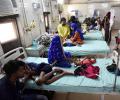
The sudden spike in cases of fever in India has claimed over 100 lives in five states, including UP, MP, Bihar, Haryana, and West Bengal. In UP, Firozabad and Mathura alone have reported 72 cases.

The company said that while the first quarter numbers were at the pre-pandemic levels, it saw a growth of 34 per cent in sales compared to the April to June period of 2020.

When Amit Jatia, vice-chairman of Westlife Development (WLDL), which operates fast-food chain McDonald's in West and South India, wanted to become the American fast-food giant's local partner in 1995, he had to first convince his family he would remain a staunch vegetarian. As McDonald's - home of the iconic Big Mac - completes 25 years in India, being one of the largest operators in the quick-service restaurant (QSR) segment in the country with over 300 outlets, Jatia has held on to the promise he made to his family. Not one to sit back and watch anyone flip the Big Mac, he gets straight to the meat of the matter when he says McDonald's success menu will see the QSR expand its ever-hungry 'foodprint' by doubling the number of joints and increasing its average unit volume by 35-40 per cent in five years.

Enter the fireworks city of Sivakasi in Tamil Nadu and you can smell a familiar mix of sulphur, potassium nitrate, aluminium and carbon - familiar because if you've ever burst crackers, say on Diwali or Onam, chances are they were made here. Almost every household used to contribute to India's festive joy by contributing almost 90 per cent of the fireworks made in the country. Before the pandemic, around 300,000 people worked in the industry directly and another 500,000 indirectly. Located 540 kilometres from Chennai, Sivakasi is famous for its fireworks and crackers, along with printing and matches, but is almost a ghost town these days.

The Indian Medical Association states that cases are likely to rise further before coming down in Kerala as about 50 per cent of its population is still susceptible to the virus.

From social engineering to bearing the cost of COVID-19 treatment to financial reconstruction of Tamil Nadu's debt the debutant chief minister is emerging as a leader with a difference, says Shjne Jacob

In a first step towards succession plan, Chennai-based fast-moving consumer goods (FMCG) major CavinKare on Monday announced the restructuring of its businesses and also roped in the generation next giving charges of separate business verticals. Announcing the restructuring on Monday, CK Ranganathan, chairman and managing director of CavinKare indicated that the business will be split into mainly four different streams - FMCG, ecommerce, retail and research and development.
.jpg)
The Union government's offer of settling the retrospective taxation case with Cairn Energy may hinge on Vedanta withdrawing the ongoing arbitration from the Singapore Tribunal on the same issue. The government has offered to refund Cairn Energy Rs 7,900 crore that it had collected under the retrospective tax demand on fulfilment of certain conditions, including withdrawal of pending litigation and furnishing of an undertaking to the effect that no claim for cost, damages, interest, etc., would be filed. This condition is also part of the Taxation Laws (Amendment) Bill, 2021, passed by Parliament recently.
Bad management, an exhausted government vigilance mechanism, delay in roping in private players, relaxing norms, and over-dependence on antigen tests may be the reason behind the surge, reports Shine Jacob.

The government may look at areas around Thonnakkal, in Thiruvananthapuram district, for the facility. If successful, this would be one of the few sites of Sputnik V owned by Russian firms outside that country. Shine Jacob and Sohini Das report.

US tech giant Microsoft is in the final stages of talks with the Telangana government to set up a data centre with a total investment of Rs 15,000 crore. According to sources in the state government, the company has zeroed in on a land parcel near Hyderabad for the facility. "In the information technology (IT) space, Telangana is already seeing some major investments. "Microsoft is establishing its data centre here, and it may come out with a public announcement soon," said a source.

India's largest garment hub Tirupur continues to reel from the effects of the pandemic, with almost 10 per cent of its orders for the upcoming season getting diverted to Bangladesh, Vietnam, Cambodia and China. The sector had seen a drop of about 9 per cent in exports during the first wave, but the impact is likely to be more this time, according to industry experts. Being one of the epicentres of Covid cases in the state, a majority of manufacturing units in the textile belt were closed for almost six weeks during the second wave.

Is there more than meets the eye to Kitex Garments, the world's second-largest children's garment producer, abandoning Kerala for Telangana?
The government of Tamil Nadu on Tuesday signed a memorandum of understanding (MoUs) with 35 companies that may see investment to the tune of Rs 17,141 crore, creating employment opportunities for 55,054 people. The major companies that would be coming up with fresh investments over Rs 1,000 crore in the state include JSW Renew Energy Two, TCS, ZF Wabco and Srivaru Motors among others. JSW Renew Energy Two will be coming up with a 450 megawatt (Mw) wind power generation unit at Tuticorin, Tirunelveli, Dindigul and Tiruppur for Rs 3,000 crore. TCS will be coming up with its third phase of expansion at SIPCOT IT Park in Siruseri, ZF Wabco with an auto component unit at Kancheepuram for Rs 1,800 crore and a two-wheeler EV unit by Srivaru Motors for Rs 1,000 crore at Coimbatore.

The survey covered 1,210 IT executives and technology professionals from North America, the United Kingdom, Australia, New Zealand, Singapore and India. In India, 202 respondents from businesses with more than 500 employees across 18 industry verticals completed the survey. Overall, 89 per cent of the respondents said implementing a work-from-home policy had increased security challenges for their organisations. The risk posed by shadow IT was especially high, with 89 per cent of companies having no control over the software that employees purchase and install on their devices.

More than a year of Covid-19 has pushed most businesses into gloom but Reliance Industries Ltd (RIL) managed to reduce its gross debt 25 per cent, enabling it to turn towards its next phase of capital expenditure that has come in the form of a Rs 75,000-crore plan for green energy and power storage. The company managed to stay afloat during the pandemic because of its large presence in the consumer-centric businesses of retail and telecommunication (see chart: "A new Reliance"). These two businesses constituted 45 per cent of its EBITDA during FY21 from 36 per cent in FY20.
 © 2026 Rediff.com - Investor Information - Advertise with us - Disclaimer - Privacy Policy - Sitemap - Feedback - About us - Terms of use - Grievances